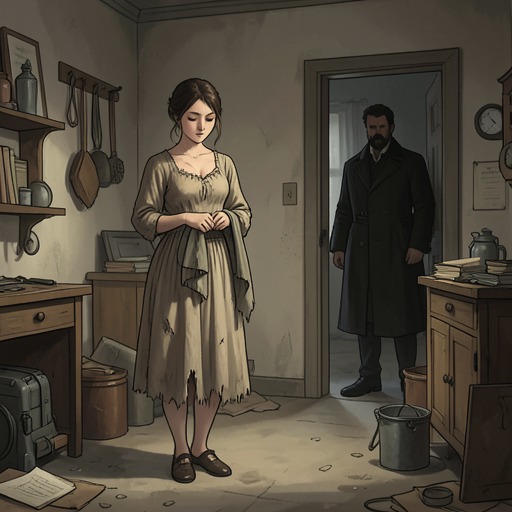
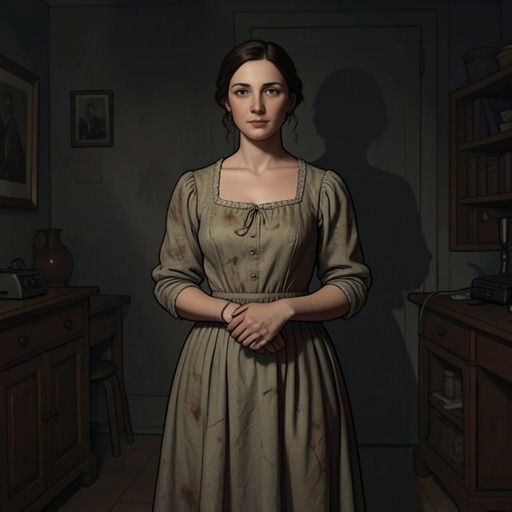
Bathsheba's discovery of Fanny and her child
Far from the Madding CrowdBathsheba's discovery of Fanny and her child transforms a hidden suspicion into an irreversible reckoning with Troy's past and the reality of their marriage. The scene brings the dead Fanny into the center of the living couple's conflict: Bathsheba learns what Troy's conduct has meant, while Troy, confronted with the woman he abandoned, openly declares that Bathsheba is nothing to him.
Causes and Background
After watching Gabriel pray in the quiet of his dwelling, Bathsheba returns to her own house more agitated by the contrast between his apparent peace and her distress. Her attention is fixed on the room where Fanny lies, and she longs to know whether Fanny's death has revealed a secret about Troy. She cannot bring herself to ask Gabriel about the cause of Fanny's death, so she is left to suspect and guess alone.
Bathsheba's uncertainty becomes intolerable. In the hall, she imagines that if she could look at Fanny for a moment, she would know the truth. She then goes to the lumber closet for a screwdriver and enters the room where the coffin has been left uncovered. The narration presents her action as something she later cannot explain: she follows the resolve as if in a dream, listening for the sleeping maids, opening the door, and proceeding despite the fact that she would have been horrified to anticipate doing this alone at night.
The Discovery
Beside the coffin, Bathsheba sees Fanny and the infant together. She understands that this is the answer she has sought, and the sight brings not simple grief but a complicated response shaped by what Fanny's story means for her. Fanny's death, which had seemed to leave her humiliated and defeated, now appears in Bathsheba's distressed imagination to have given the dead woman an unanswerable ascendancy over the living. The yellow hair framing Fanny's face makes the connection to the curl Troy possesses difficult to doubt.
Bathsheba's thoughts swing between resentment and shame at feeling resentment toward a dead woman. She imagines Fanny as a rival who has returned pain for pain, then recoils from the thought as cruel and unjustifiable. The revelation does not make her anger simple: she is horrified by her own antagonism even as she struggles with its force. She kneels beside the coffin, partly following the example of Gabriel's prayer, and rises with a quieter spirit and a wish to make amends. Because she knows no other way to show kindness to the dead, she takes flowers from a vase and lays them around Fanny's head.
Troy Recognizes Fanny
The interruption comes when the coach-house doors slam and Troy enters the house. He finds Bathsheba pallid beside the coffin, but at first he does not connect the scene with Fanny; he thinks someone in the household has died. Bathsheba tries to leave, asking for air, while Troy insists that she stay and takes hold of her hand. Together they approach the coffin, where the candlelight makes the faces of Fanny and the child visible.
Troy recognizes Fanny and becomes motionless as the truth settles over him. When Bathsheba asks whether he knows the woman, he answers that he does; when she asks whether it is Fanny, he confirms it. His shock gives way to grief. He sinks to his knees and gently kisses Fanny, an act that Bathsheba experiences as unbearable. The encounter turns the discovery into a direct confrontation: what she has learned by looking into the coffin is now displayed in Troy's own response to the dead woman.
The Marriage Broken Open
Bathsheba first reaches for Troy in a sudden, desperate appeal, asking him not to kiss Fanny and begging him to kiss her too. The appeal briefly reveals a vulnerability sharply at odds with her usual independence. Troy pushes her away and refuses. When Bathsheba asks for his reason, he calls himself a bad man, then says that Fanny, even dead, means more to him than Bathsheba ever has or can. He blames his temptation on Bathsheba's face and coquettish manner, turning his own betrayal into an accusation against her.
His next words make the rupture explicit. Calling Fanny his darling and wife, he tells Bathsheba that she is nothing to him and that a ceremony before a priest does not make him morally hers. The discovery therefore reveals more than the past connection between Troy and Fanny: it exposes the emptiness of the marital bond as Troy now defines it. Bathsheba's desperate question about what she is to him is met not with explanation or comfort but with rejection. She runs from the room at once.
Consequences and Significance
The scene reverses the meanings Bathsheba had tried to assign to Fanny's death. She had feared that the dead woman's story would confirm her own shame; at the coffin, Fanny's vulnerability and Troy's visible remorse make Bathsheba confront the human cost of the history she had only suspected. Her response moves from curiosity to shock, resentment, prayer, attempted kindness, and then the renewed attachment that makes Troy's rejection so devastating.
The scene also joins physical recognition to emotional exposure. The coffin, the child's body, Fanny's yellow hair, and the flower offering are not incidental details: they make the concealed relationship visible and material, while Troy's kiss confirms its emotional weight. His words then destroy Bathsheba's expectation that marriage provides even a claim upon him. By the time she runs from the house, the secret has become a crisis in the present, and the discovery's most immediate consequence is not resolution but the collapse of her security as Troy's wife.